
HISTORICAL DOCUMENTS & TRANSLATION
Unlock the meaning behind historical documents.
Professional historical translation and transcription for manuscripts, records and related documentary material—combining linguistic care with historical context and transparent evidential limits.
- Document-led
- Historically informed
- Individually scoped

SERVICES
Professional historical-document work, shaped by the source.
Each document is considered for language, script, legibility, condition, date, complexity and the purpose of the enquiry.
Translation
Professional rendering of historical-document meaning into or from English within the agreed language and research scope.
Transcription
Accurate reproduction of readable original text in a clear, typewritten form.
Transliteration
Conversion of writing from one script into another script for reading, reference or further research.
Handwriting Interpretation
Careful reading and identification of difficult historical handwriting where condition and legibility permit.
Document Identification
Assessment of apparent language, form, purpose, date and documentary type.
Historical Context & Interpretation
Explanation of terminology, references and documentary content within its appropriate historical setting.

SUPPORTED LANGUAGES
A defined multilingual research scope.
Language capability is applied according to the historical document itself and the requirements of the agreed project.
Translation into and from English is available depending on the language, document type and project requirements.
DOCUMENT TYPES
Documents are assessed before the work is defined.
Suitability depends on script, legibility, condition, language, date, complexity and scope. No document is assumed to be fully readable or suitable for translation before review.
Registers
Letters
Certificates
Court Materials
Family Documents
Manuscripts
Marginal Notes
Official Correspondence
Property Documents
Inscriptions
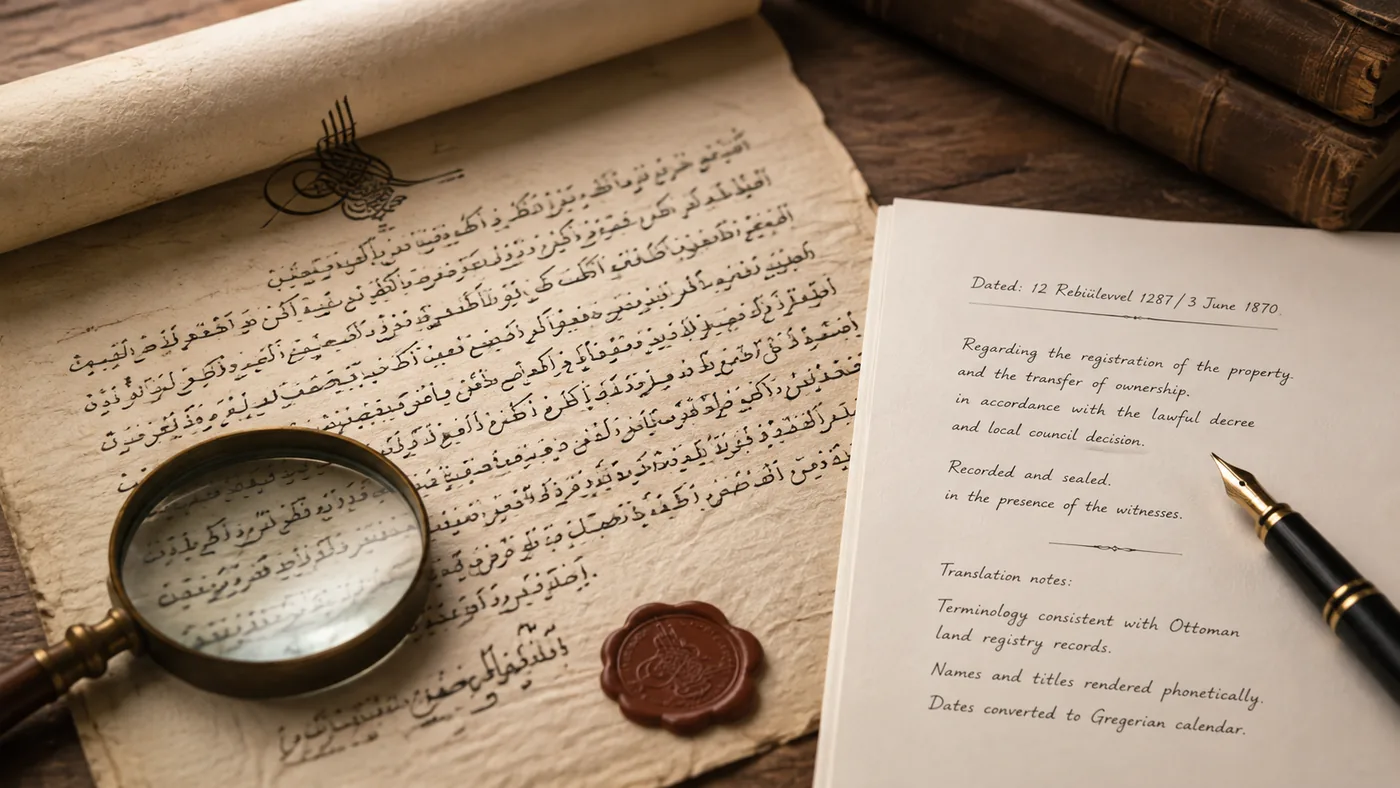
ASSESSMENT PROCESS
A clear written route from enquiry to delivery.
Submitting an enquiry does not create a contract or begin paid work. Scope and quotation are confirmed first.
Submit Document
Send a written enquiry describing the document and the assistance required.
Review
The material and available context are considered for language, legibility and suitability.
Scope Confirmed
Proposed work, outputs and relevant limitations are set out in writing.
Written Quotation
A written quotation is provided before translation or research begins.
Translation / Research
Work begins only after the proposed scope has been approved.
Delivery
The agreed written work is delivered with appropriate notes and stated limitations.
No standard public price applies. Each document service is reviewed and quoted according to the proposed scope.

DOCUMENT ASSESSMENT
Have a historical document you would like us to assess?
Begin with the existing written enquiry form. The current public form does not accept file uploads. If the enquiry is suitable, arrangements for providing relevant documents securely are confirmed as part of the assessed enquiry process.
When requested, suitable digital copies may include PDF, JPG, JPEG or PNG. Please do not send original physical documents.

IMPORTANT TERMINOLOGY
Clear language for different kinds of document work.
Translation
Rendering meaning from one language into another.
Transcription
Reproducing the original text accurately in readable, typewritten form.
Transliteration
Converting writing from one script into another script.
Handwriting Interpretation
Reading and identifying difficult historical handwriting.
Historical Context & Interpretation
Explaining documentary content within its appropriate historical setting.
DOCUMENT-SPECIFIC FAQ
Questions before submitting a historical document enquiry.
Initial suitability depends on the material provided and the question to be assessed.
What types of historical documents can you assess?
Possible material includes registers, letters, certificates, court and family documents, manuscripts, marginal notes, official correspondence, property documents and inscriptions. Suitability depends on the supplied copy, language, script, condition, date and scope.
Which languages do you work with?
The approved language scope is Ottoman Turkish, Turkish, English, Arabic, Persian, Kurdish, Azerbaijani and Kyrgyz. Each enquiry is reviewed according to the document type, language and project requirements.
What is the difference between translation and transcription?
Translation renders meaning into another language. Transcription reproduces the readable original text in typewritten form. A project may require one or both.
Can difficult handwriting be assessed?
Yes, where the supplied image and surviving text permit. Condition, legibility, historical hand, abbreviations and documentary context can affect what can be read.
Do you translate Ottoman Turkish documents?
Ottoman Turkish is within the approved language scope. The document is first reviewed for script, legibility, condition, complexity and the work required.
What happens if part of a document cannot be read?
Unreadable, damaged or uncertain passages are identified rather than silently guessed. Partial transcription, translation or contextual interpretation may still be possible.
How do I submit a document for assessment?
Begin through the Start Your Enquiry form and describe the document and question. If the enquiry is suitable, arrangements for providing relevant digital copies are confirmed through the written assessment process.
HISTORICAL DOCUMENT ASSESSMENT
Need help understanding a historical document?
Start with a written enquiry describing the document, its known context and the assistance required.