
Introduction
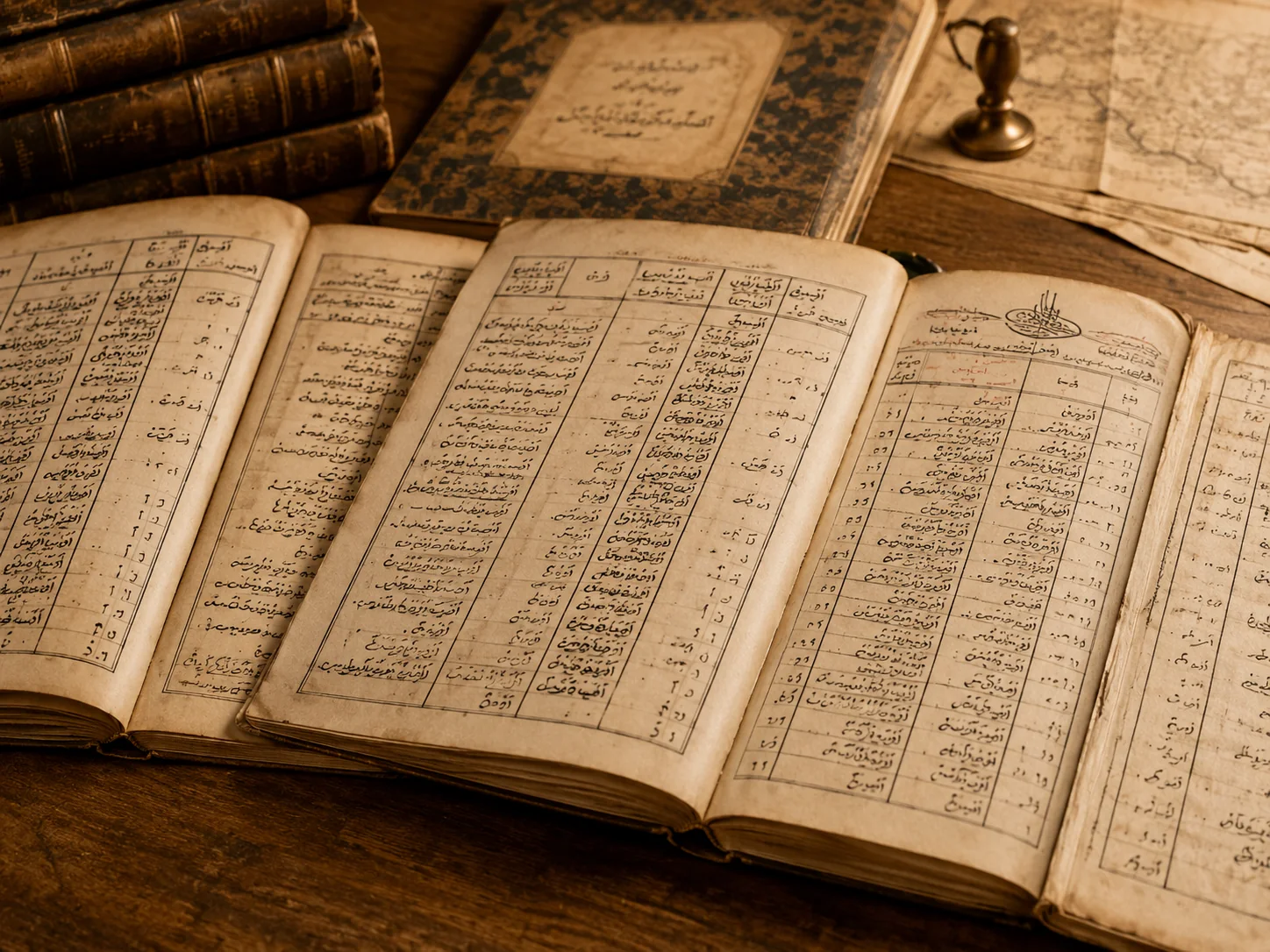
Population-related registers can be valuable sources for Ottoman family-history research, but they require careful reading. They were created for particular administrative purposes, in particular places and periods, rather than to answer a modern family-history question. A register may preserve names, ages, occupations, household arrangements, status information, places of origin or later updates. It may also omit information that a present-day researcher would most like to know.
The starting point is therefore not to ask whether an Ottoman population register can provide a complete family tree. It is to ask what a particular register was designed to record, who was included, how the information was organised and what other evidence is needed to interpret it responsibly.
Table of Contents
- What are Ottoman population registers?
- Why were they created?
- What can a register record?
- Household entries and family relationships
- Names, ages and historical geography
- Women, children and changing registration practice
- Coverage, survival and evidential limits
- Using population records within wider family-history research
What are Ottoman population registers?
The phrase “Ottoman population register” can describe more than one kind of historical material. Ottoman administrative records developed over a long period, and record types, purposes and coverage changed with chronology, locality and administrative reform. A term such as *nüfus defteri* is often translated as “population register”, but the English translation should not conceal those differences.
For nineteenth-century research, *nüfus* registration was connected with state administration, including population management, taxation and military concerns. Stanford J. Shaw’s study of the Ottoman census system shows that registration developed through changing nineteenth-century arrangements rather than through one unchanging census model. Later regulations created more extensive registration systems, but the information recorded and the degree of coverage still depended on the period and local administrative setting.
Earlier Ottoman documentary systems may also contain population-related information. Some fiscal and administrative registers record households, taxpayers, settlements or other categories relevant to social and family history. These records should not automatically be read as direct equivalents of later *nüfus* registers. Their administrative purpose affects both what they preserve and what they leave out.
For family-history research, this distinction is practical. The name of a record type alone is not enough to establish what can be expected from it. A productive enquiry considers the historical period, the place, the community, the relevant administrative framework and the question being asked.
Why were they created?
Population registration was not originally designed to create a modern genealogical database. In the early nineteenth-century registers examined by M. Erdem Kabadayı and Efe Erünal, the state’s purposes included military recruitment, the administration of poll-tax obligations, fiscal planning and the monitoring of movement. The registers were updated with information such as births, deaths, migration and changes connected with military or tax status.
That administrative purpose matters. It helps explain why one register may contain a physical description, occupation or tax category, while another does not; why some people appear in separate categories; and why an entry may be updated at a later date. It also explains why a record can be highly valuable for identifying a person in a particular locality without providing a complete account of that person’s wider family.
A register can therefore be read in two ways at once. It is evidence about an individual or household, but it is also an administrative document created through a particular historical system. Responsible interpretation keeps both dimensions in view.
What can a register record?
The contents of a population-related register are source dependent. In the 1839 Bursa registers studied by Kabadayı and Erünal, entries for male residents could include names, titles or family names, age information, occupations, physical descriptions, relationships within a household, tenancy or employment ties, military status and poll-tax categories. The same study shows that the register system also recorded particular non-household settings separately, including some inns, religious institutions, workplaces and nomadic encampments.
This does not mean that every Ottoman population-related record contains every one of these fields. Nor does it mean that every entry is equally complete or equally easy to interpret. A field may be absent because it was not required in that series, because a local practice differed, because the person fell outside the principal category of registration, or because the surviving copy is incomplete.
For a genealogical enquiry, useful information may include:
- a personal name and any descriptive addition;
- an approximate age or age category;
- a quarter, village or wider locality;
- an occupation, office or social designation;
- a place of origin or migration note;
- an indication of household membership;
- an update concerning birth, death, movement or absence.
Each item should be treated as evidence in context. A recorded age may be approximate. A descriptive term may have an administrative function rather than a family meaning. A place may refer to residence, origin, registration location or another relationship to locality.
Household entries and family relationships
A household is not automatically a modern nuclear family, and household proximity is not by itself proof of biological kinship. In the Bursa material, the household was the basic unit of entry, but its form could vary according to setting. The same research records kinship, tenancy and employment relationships within household entries. This is an important reminder that people listed together may have had different kinds of connection.
A household entry can nevertheless be highly useful. It may place individuals in a shared residential or administrative context, identify an apparent relationship, show a father’s name, or reveal a pattern that can be tested against other records. It may also help distinguish two people with similar names by associating them with a particular locality, occupation or group of residents.
The evidential step is crucial. Recording a household is not identical to proving every claimed family relationship within it. A shared surname, patronymic, locality or residence does not automatically establish descent. Where a register contains an explicit relationship, that wording should be read closely. Where it does not, the connection may remain supported, possible or unresolved until compared with further documentary evidence.
A careful investigation may therefore combine population material with family papers, court records, inheritance-related historical documents, waqf material, civil registration, cemetery evidence, published local studies or other relevant sources. The appropriate comparison depends on the period, region and historical question.
Names, ages and historical geography
Names are often central to archival identification, but they are rarely self-explanatory. Spellings, titles, patronymics, occupational designations and local naming practices can vary. The same person may be described differently across records, while several people in the same locality may have similar names.
A useful research question begins with what is known: possible name forms, an approximate date range, known places, religious or communal context where relevant, family tradition and previous documentary references. It also records what remains uncertain. This helps distinguish a documented fact from a research hypothesis.
Place identification requires the same care. Modern national borders, provincial divisions and place names do not automatically map onto Ottoman administrative geography. A locality may have been recorded under a historical village, quarter, district or provincial framework that differs from its present designation. The administrative units used in a register should be understood on their own terms before modern equivalents are assumed.
This is one reason why historical geography is not an optional background detail. It shapes which records may be relevant, how a catalogue description should be read and whether two apparently similar place names refer to the same locality.
Women, children and changing registration practice
It is not accurate to state simply that women were absent from Ottoman population records, or that all household members were consistently recorded. Coverage changed over time and could vary by record type, region and administrative purpose.
The early nineteenth-century registers discussed by Kabadayı and Erünal focused on male inhabitants. Their Bursa study notes that households without male members could sometimes be identified through the name of a female household head, without full personal details for everyone in that household. Later registration systems could be more comprehensive. Shaw describes later nineteenth-century regulations that included women and provided fields for personal information such as residence, age, religion, occupation and marital status.
Even later inclusion did not guarantee complete coverage everywhere. Ahmet Yadi and Mucize Ünlü’s study of women in Ottoman censuses notes both the inclusion of women in the 1881 registration process and practical difficulties that meant some women were not registered in particular circumstances.
For family-history research, the correct question is therefore: who was meant to be recorded in this specific series, at this date and in this locality? The answer may materially affect the conclusions that can safely be drawn from an apparent absence.
Coverage, survival and evidential limits
A surviving register represents what was recorded in a particular administrative process; it does not necessarily represent the whole population, every event or every later family connection. Kabadayı and Erünal note that nineteenth-century registration coverage differed across regions and that updates could be made after initial registration. They also caution that some events, particularly births, were not reported and that an update date may reflect registration rather than the precise date of an event.
Source survival creates a further limitation. A record may once have existed but no longer survive, may be catalogued under a different administrative unit, may not yet be digitised, or may be difficult to identify without a more precise historical location. A catalogue result, or the absence of one, should not be treated as a final answer before the relevant historical context has been assessed.
Population records can strengthen a family-history reconstruction, but they do not guarantee an uninterrupted line, a complete household history or the discovery of a particular ancestor. Research outcomes depend on the surviving evidence and the scope agreed for the enquiry.
Using population records within a wider genealogical investigation
The most useful approach is question-led. Begin with the person, household, locality or period that needs investigation. Separate known documentary facts from family tradition and from questions that remain open. Record alternative spellings, approximate dates, historical places and any previous source references.
Then ask what kind of administrative record may have been created for that context. A population-related register may help identify a person, distinguish namesakes, place a household in a locality, identify migration or absence, or provide details that guide further research. It may also demonstrate that a proposed connection remains uncertain.
The value of the source lies not in a promise of a complete answer, but in disciplined comparison. Population records are strongest when their administrative purpose, scope and limits are understood, and when their entries are assessed alongside other relevant historical evidence.
Sources & Further Reading
- M. Erdem Kabadayı and Efe Erünal, “A nineteenth-century urban Ottoman population micro dataset: Data extraction and relational database curation from the 1840s pre-census Bursa population registers,” *Scientific Data* 11, 570, 2024.
- Stanford J. Shaw, “The Ottoman Census System and Population, 1831–1914,” *International Journal of Middle East Studies* 9, no. 3, 1978, pp. 325–338.
- Gilles Veinstein, “Les registres de recensement ottomans. Une source pour la démographie historique à l’époque moderne,” *Annales de Démographie Historique*, 1990, pp. 365–378.
- Ahmet Yadi and Mucize Ünlü, “Inclusion of Women in the Census in the Ottoman Empire and the Challenges Faced During This Process,” *Belgi Dergisi*, no. 28, 2024, pp. 225–242.
Related Articles
- Planning an Ottoman Archival Research Question
- What to Do When Family Records No Longer Survive
- Preparing Material for an Ottoman Historical Research Enquiry
APPLYING RESEARCH TO A SPECIFIC QUESTION
Explore the research approach relevant to your material
A Journal article can clarify a source, method or historical term, but a live research question requires attention to its own evidence and context. Explore the Research Areas, or submit the available information in writing for assessment.